You made sales last week. Maybe even good sales. And then, somehow, quietly — they stopped.
No dramatic campaign failure. No sudden change in the market. You just… stepped away for a few days, and the income stopped with you.
If you’ve been trying to build an online business and this pattern sounds painfully familiar, you’re dealing with the most common and least-talked-about problem in digital marketing: you don’t have a sales system. You have a sales effort. And effort, unlike a system, stops working the moment you do.
This post breaks down exactly why consistent online income feels so elusive — and more importantly, the specific approach that separates marketers who generate sales every single day from those still riding the feast-or-famine rollercoaster. By the time you finish reading, you’ll understand the structural reason your current approach isn’t working, and you’ll have a clear picture of what to build instead.

Stop trading effort for income and start building something that runs
Why Learning More Tactics Isn’t Making You More Money
If you’ve been trying to figure out how to generate consistent daily sales online, you’ve probably already tried the obvious things. You posted content consistently for a while. You ran an ad or two. Maybe you built a funnel, followed a launch formula, or modeled a successful campaign from someone you admired. And some of it worked — just not reliably.
Here’s the problem. Most of what gets taught in the online marketing space is campaign-based thinking disguised as strategy. Launch a product, run a promotion, spike your sales for a week, and then watch the numbers fall back to zero until the next campaign. This approach isn’t broken — it can generate money — but it creates an income that’s completely dependent on your constant active involvement. Miss a week, and the revenue disappears with you.
The frustration most marketers feel isn’t a skill gap. It’s an architecture problem. They’ve built a hustle, not a machine. Tactics without an underlying system will always create temporary results, no matter how good the tactics are. The marketers who seem to effortlessly generate income daily aren’t smarter or luckier — they’ve simply built their businesses on a fundamentally different structural foundation.
What Does a “Sales System” Actually Mean — and Why Do Most Marketers Not Have One?

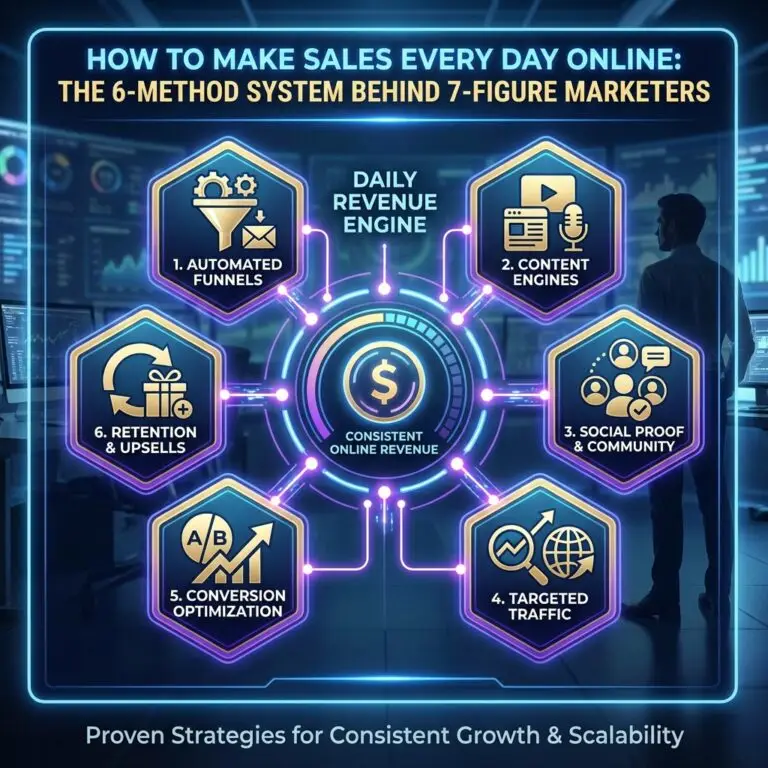
The phrase gets thrown around a lot, but here’s a clear, working definition: a sales system is a set of interconnected strategies that continue generating revenue independently of your daily activity. Not one strategy. Not a funnel you built once. A layered, compounding set of revenue mechanisms that each contribute to daily income — so that when one is quiet, the others are still running.
This is the core insight behind what veteran digital marketer Kevin Fahey has built over the past 15 years. Rather than relying on any single income stream, his approach uses six distinct sales methods simultaneously — each designed to produce revenue on its own, but collectively creating what he describes as a “snowball effect” where income compounds and grows more reliable over time, not less.
This matters because most marketers structure their business like a single-engine plane. When that one engine sputters — a campaign underperforms, a traffic source dries up, an algorithm shifts — the whole thing goes down. A multi-method system, by contrast, functions like a commercial aircraft. Individual components can underperform without bringing down the whole operation.
The six methods Fahey teaches aren’t secret in the mystical sense — they’re documented, teachable, and proven. What makes them powerful is how they’re built to work in combination, and how deliberately they’re designed to require minimal maintenance once they’re set up correctly.
How to Actually Build a System That Makes Sales Every Day
Building a consistent daily sales system starts with accepting one uncomfortable truth: if you’re currently making sales, but only when you’re actively pushing, you haven’t built a business yet. You’ve built a job — and a stressful one at that. Here’s the framework for shifting that.
Step 1: Stop optimizing a single channel. Most struggling marketers have one traffic source and one offer. When that channel shifts, everything shifts. A real system diversifies across at least three to four revenue mechanisms that don’t share the same dependencies.
Step 2: Build for compounding, not conversion. Every piece of content, every email sequence, every piece of organic infrastructure you build should continue working after you publish it. If your primary daily income comes from things that stop the moment you stop, you’re building on sand.
Step 3: Install a communication framework. One of the most underestimated components of consistent sales is knowing exactly when and how to communicate with your audience at each stage of their relationship with you. The difference between a list that buys regularly and one that goes cold is almost always rooted in the communication strategy — not the offer quality.
Step 4: Let the system run and measure, not manage. Once the foundational pieces are in place, your job shifts from doing to monitoring and optimizing. This is where the “hands-off” element becomes real — not because everything runs itself from day one, but because a well-built system requires dramatically less active input than a hustle-based business.
If you’d rather not spend the next year figuring this out through trial and error, Kevin Fahey’s 365 Sales System walks through exactly this framework — the six specific methods he uses, the campaign planning tools his team uses internally, and real case studies showing how each method works inside an active business.
What Realistic Results Look Like When This Works
It’s worth being direct about expectations here, because the online marketing space has a serious credibility problem with overclaiming.
Building a system that generates daily passive income is not a weekend project. Marketers who’ve gone through structured training like the 365 Sales System and implemented consistently report meaningful shifts within weeks — not days, and not years. Val Wilson, one of Fahey’s students, noted that the six methods covered gave her a clear monetization path for her existing list that she hadn’t previously considered, with the training being “highly recommended for anyone working online.” JayKay Dowdall’s assessment was pointed: “No loopholes, no hacks, no fluff — if you use these six systems, you’ll make more sales.”
What the data from students who implement these strategies consistently shows is a gradual shift from income spikes to income floors. In practical terms: instead of making $2,000 one week and $0 the next, you start building a baseline of recurring daily revenue that becomes the new floor — and then grows from there.
That’s not passive income in the “do nothing forever” sense. It’s a business that runs without requiring your hands on it every hour of every day. For most people reading this, that’s exactly what they’re actually trying to build.
The One Thing That Changes Everything
Here’s the simplest summary of everything above: the difference between inconsistent and consistent online income is almost never the quality of your offers, your content, or your traffic. It’s whether you have a system — a layered, compounding set of revenue mechanisms that don’t all stop when you do.
Tactically, that means diversifying your sales methods, building communication frameworks that nurture your audience on autopilot, and creating content and infrastructure that continues working long after you publish it.
If you want to see how this is structured in practice — including the actual six methods Fahey has used to generate daily sales for over a decade — the full breakdown is at omarsaady.com/the-365-sales-system. It’s worth visiting not just for the training, but for the case studies that show exactly how each method is applied inside a real, active business. That level of transparency is rare in this space, and it’s where the real education happens.
Frequently Asked Questions
Does a daily sales system work for beginners, or do you need an existing business?
A daily sales system can be built from scratch — in fact, starting with the right architecture from the beginning is easier than trying to retrofit a system onto a business that was built without one. The key is understanding the framework before you build, not after. Several of Fahey’s students built their first consistent income streams starting with no audience and no existing products.
How long does it take to generate consistent daily passive income online?
Realistically, most marketers who implement a multi-method sales system start seeing consistent baseline revenue within 30 to 90 days of focused implementation. “Passive” in the true sense — where the system runs largely without daily input — tends to develop over three to six months as the compounding mechanisms gain traction.
What’s the difference between a sales system and a sales funnel?
A funnel is a single pathway — one traffic source, one sequence, one offer. A sales system is a collection of funnels, email frameworks, content assets, and revenue mechanisms that work in combination. A funnel can stop working overnight. A system, because it has multiple components, is far more resilient. This is why marketers with sophisticated funnels still often struggle with inconsistent income — a great funnel is only one piece of what’s needed.