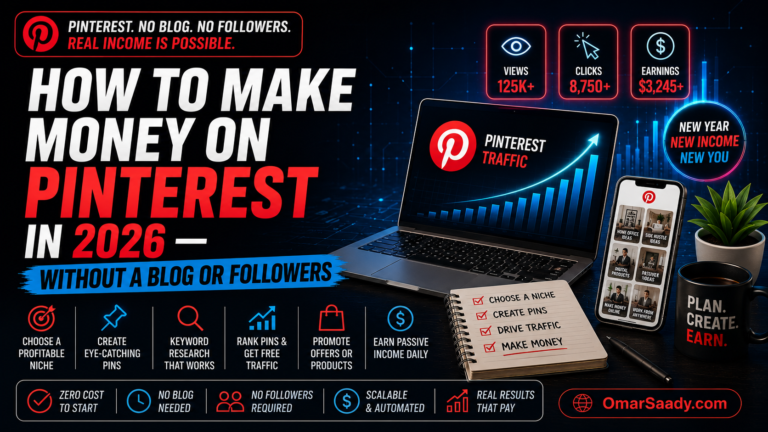
How to Make Money on Pinterest in 2026 — Without a Blog or Followers
Pinterest is a search engine, not a social network. Here are 5 methods that turn pins into income. No followers needed. No paid ads. No website needed to start.
Most people think of Pinterest as a social media platform. That is the wrong mental model. Pinterest is a search engine. People type in what they want. Pinterest then shows them content that matches — no matter who made it or how many followers they have.
That changes everything for beginners. On Instagram or TikTok, you need followers before you get reach. On Pinterest, a pin you create today can reach thousands of people tomorrow — based entirely on keywords, not popularity.
I have used Pinterest as a primary free traffic source for years. It drives email members, affiliate clicks, and digital product sales. And it does this from pins I created months ago — with no daily upkeep needed. Here is how it works.
The 5 main ways to make money on Pinterest:
- Affiliate links — pin right to affiliate offers or review pages
- Email list building — pin to a free lead magnet, monetise via email sequence
- Digital product sales — pin right to Etsy, Gumroad, or your own listing
- Blog traffic — drive readers to affiliate-linked posts
- Pinterest Creator Fund — paid for high-engagement Idea Pins (US/select markets)
Best starting method: email list building. A subscriber from Pinterest is worth far more than a single click. They receive your full email sequence — multiple offers, delivered with time.
Why Pinterest Still Works in 2026 — The Search Engine Advantage
Pinterest has over 500 million monthly active users. But the number that matters most is not the user count. It is the search behaviour. Over 80% of Pinterest sessions start with a search query. People arrive on Pinterest looking for something specific. And when your pin answers that search, it shows up — even on a brand-new account.
This is the key difference between Pinterest and every other platform. On Pinterest, your content’s relevance matters more than your reputation. A well-designed pin with the right keywords beats a poorly-optimised pin from a large account.
Why pins compound with time
The average lifespan of a Pinterest pin is 3+ years. Compare that to a Facebook post (5 hours), a Tweet (15 minutes), or an Instagram post (48 hours). A pin you create today is still driving traffic in 2028. That compounding is why Pinterest is one of the best free traffic sources for affiliate marketers.
The 5 Methods — How Each One Works
Pinterest allows you to link pins right to affiliate offers. You create a pin that shows the value of the product. Focus on the result — not the features. Then link it to your affiliate URL. When someone clicks the pin and buys the product, you earn the commission.
This is the simplest method. But it has a limitation. A single click is a one-time chance. If the visitor does not buy right away, they are gone. For higher-priced products or offers that need more trust, a bridge page or email list converts better.
Best for: Low-cost impulse products under $50, tools and resources, digital downloads.
⏱ Fastest to set up — 30 minutesThis is the method I use most. Here is how it works. You create a lead magnet — a free checklist, template, or email mini-course. You create a free opt-in page on AWeber or LeadsLeap. You design pins in Canva that show the lead magnet’s value. Every pin links to your opt-in page.
When someone opts in, they receive the lead magnet and enter your automated welcome sequence. That sequence introduces affiliate tips over 5 to 7 emails. One Pinterest subscriber is worth far more than one affiliate click — because you get multiple conversion chances with time.
Best for: Long-term income, affiliate marketing, any niche where trust matters.
📈 Best long-term ROI of all 5 methodsEtsy and Gumroad both integrate directly with Pinterest. You list a digital product — a template pack, a Notion dashboard, a prompt collection, or a printable. Then you pin right to the listing. When someone buys, the product delivers on its own. No inventory, no shipping, no customer service beyond a simple FAQ.
Pinterest works especially well for Etsy shops. Both platforms attract buyers who are actively looking — not passively scrolling. That buyer intent converts better than social media traffic.
Best for: Designers, creators, anyone with a digital product to sell.
🛍️ Works with Etsy and Gumroad directlyIf you have a blog, Pinterest is one of the best sources of free traffic available. You create pins for each blog post. When someone clicks the pin and reads the post, they encounter your affiliate links in context. They are already interested in the topic. So they are far more likely to click and buy than a cold visitor with no prior interest.
Blog posts also get indexed by Google with time. So the same article earns from both Pinterest traffic and Google search traffic at the same time. That double-channel effect makes blogging with Pinterest one of the most efficient income setups for affiliate marketers.
Best for: Bloggers, content creators, affiliate marketers with existing content.
✍️ Double traffic — Pinterest + GooglePinterest’s Creator Fund pays eligible creators for Idea Pins that achieve high engagement. Payouts vary by region, content type, and engagement metrics. This method requires no external product or affiliate offer — Pinterest pays you directly based on content performance.
The limitation is access. Creator rewards are now offered in select markets (primarily the US) and require a minimum follower threshold. For beginners outside those markets, this method is secondary to the first four. But it adds a nice income layer once your presence grows. But it adds a passive income layer once your Pinterest presence grows.
Best for: Established Pinterest creators in supported markets.
⚠️ Requires eligibility — check access firstThe Comparison — Which Method Is Right for You
| Method | Setup Time | First Income | Passive? | Best For |
|---|---|---|---|---|
| Affiliate links (direct) | 30 min | 1–2 weeks | Mostly ✅ | Simple products |
| Email list building | 2–3 hrs | 30–60 days | Yes ✅ | Long-term income |
| Digital product sales | 3–5 hrs | 2–4 weeks | Yes ✅ | Creators |
| Blog traffic + affiliates | Ongoing | 30–90 days | Mostly ✅ | Bloggers |
| Creator rewards | Varies | Varies | Yes ✅ | Established creators |
How to Set Up Your Pinterest Strategy in Under 2 Hours
Step 1 — Switch to a business account
Go to your Pinterest settings and convert to a business account. It is free. This gives you access to analytics and removes limits on pin scheduling. Add your website URL if you have one. If not, add your Gumroad or opt-in page URL instead.
Step 2 — Research your keywords
Type your niche topic into Pinterest search. Look at what autocompletes. These are the exact phrases people search for. Note the top 10. These become your pin keywords, board names, and pin text. Do this before designing a single pin.
Step 3 — Design your first 10 pins in Canva
Open Canva free. Search for “Pinterest pin” in templates. Choose a clean, readable design. Write a clear headline on each pin — ideally using one of your keyword phrases. Keep text large enough to read on mobile. Export as PNG. Design 10 variations in one session to batch your work.
Step 4 — Write keyword-rich text
Every pin needs a text with 3 to 5 keywords. Do not stuff keywords randomly. Write one or two natural sentences that describe the pin and include the keywords smoothly. Pinterest reads these text to understand what the pin is about and who to show it to.
Step 5 — Post and repeat
Post 1 to 3 pins per day for the first 30 days. Then, 5 to 7 per week maintains growth. You can also use a scheduler like Later or Tailwind to batch your posting in one weekly session. Each pin compounds. Each board you fill adds more keyword signals. The system grows while you sleep.
The 3 Mistakes That Stop Pinterest From Working
Mistake 1 — Treating Pinterest like Instagram
Pinterest is not about followers or engagement metrics. It is about search relevance. A pin with 10 saves and 500 clicks is better than a pin with 500 saves and 10 clicks. Focus on what gets clicked — not what gets liked. Clicks drive traffic. Traffic drives income.
Mistake 2 — No keywords in text
A beautiful pin with a blank or generic text gets shown to almost no one. Pinterest needs keywords to understand who your pin is relevant to. Without them, your pin has no distribution signal. Every pin text needs 3 to 5 relevant keywords written smoothly in 1 to 2 sentences.
Mistake 3 — Quitting after 30 days
Pinterest traffic builds slowly at first. The first month is planting seeds. The second month is watering them. Month three and beyond is when they compound. Most people quit in month one — right before the compounding starts. Stay consistent for 90 days before evaluating Pinterest’s performance.
Get the Free Blueprint — Build Your Email List With Pinterest
The lead magnet, opt-in page, and email setup that turns Pinterest clicks into affiliate fees — all free to access — free, no purchase needed.
⚡ Get Free Access Now