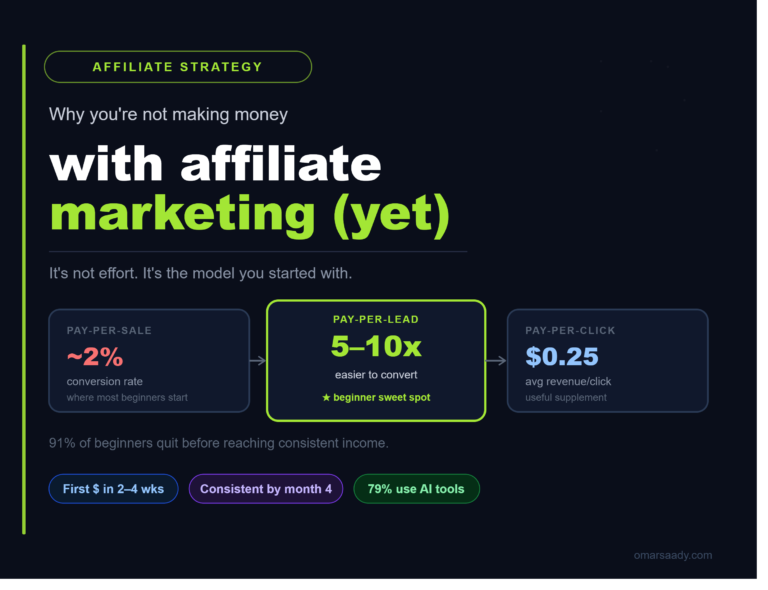
It’s not effort. It’s the model. Here’s the structural gap between what beginners are taught and what actually generates affiliate income.
✍ Omar S.K📅 May 31, 2026 · Updated June 20, 2026🏷 Affiliate Marketing · Beginners
If you’ve been searching why am I not making money with affiliate marketing, you already know the worst part: it’s not that you haven’t tried. You’ve signed up for the programs. Built the page. Posted the links. Maybe even paid for a course or two. And the dashboard still shows zero. That’s not a small frustration — it’s the kind that makes you quietly question whether the whole thing was a scam aimed at people exactly like you.
It wasn’t. But there’s a specific reason your effort hasn’t converted yet, and it’s almost never what the gurus told you it was. The honest answer isn’t “you didn’t work hard enough” or “you need to buy the next course.” It’s structural — a gap between what beginners are taught to do and what actually generates affiliate income. Once you see the gap, the fix is straightforward, and the work you’ve already done starts to compound instead of disappear.
By the end of this post you’ll understand the real reason your affiliate marketing isn’t paying yet, the three quiet mistakes that keep beginners stuck for months or years, and the simple shift that turns effort into actual commissions.
Related Reading
- Affiliate Marketing in 2026: Why Most Beginners Fail in 90 Days
- Affiliate Marketing for Beginners: The “One Post” $2,000/Month Formula
- How to Make Money Online With No Experience in 2026
The Honest Reason Most Affiliate Marketers Earn Nothing
Most people who don’t make money with affiliate marketing aren’t doing the wrong work — they’re doing the right work in the wrong order, aimed at the wrong type of payout.
The “default” path beginners are taught looks like this: pick a niche, build a website or social presence, get traffic, drop affiliate links, wait for sales. Every step is fine in theory. The trap is the last one. You’re being asked to convert cold strangers into paying customers as your first skill, and converting cold strangers to a purchase is the single hardest thing in marketing. Experienced affiliates take years to do it consistently. Beginners are essentially being asked to start at the boss level.
The numbers confirm just how hard that bar is. The average affiliate conversion rate across all niches sits at roughly ↗ 1.8–2.1% — meaning even with a hundred genuinely interested clicks, you’d expect just one or two sales. That’s not a sign you’re doing it wrong. It’s the baseline difficulty of the model most beginners are pointed toward first.
That’s why your dashboard reads zero. Not because affiliate marketing is broken, and not because you’re failing — but because you’re trying to clear the highest bar in the game before you’ve cleared the lower ones that build skill, momentum, and confidence.
The Three Quiet Mistakes That Keep Beginners Stuck
01
Chasing pay-per-sale too earlyMost beginners are funneled toward Amazon Associates or high-ticket programs that only pay when someone buys. You can do everything right and still see zero.
02
Traffic and offer don’t match intentA casual browser is worth almost nothing. Someone actively comparing solutions is worth a lot. Most beginners send the wrong audience to the wrong offer at the wrong moment.
03
Quitting during the lagThere’s a brutal delay between effort and results — often 60 to 120 days. Most people quit between days 30 and 60, right before things start compounding.
This isn’t a small dropout problem — it’s the norm. An estimated ↗ 91% of affiliate marketing beginners quit before reaching consistent income, and most who stick around still earn under $1,000 in their entire first year. The lag isn’t a sign something’s wrong — it’s the standard shape of the curve.
What Actually Generates Affiliate Income (When You’re New)
The shift that changes everything is small but it reorganizes the whole game: stop trying to earn from sales first, and start earning from actions that happen before a sale.
There are three affiliate models, not one:
Hardest to convert
Pay-Per-Sale (PPS)The one you’ve been trying. Highest payouts, hardest to convert. Built for experienced affiliates with refined funnels and warm audiences.
Beginner sweet spot
Pay-Per-Lead (PPL)You earn when someone takes a free action — entering an email, starting a free trial. Converts dramatically more often than a sale. Almost no introductory course mentions this.
Useful supplement
Pay-Per-Click (PPC)You earn from clicks alone, no sale required. Payouts are small, but the volume math is simple and predictable.
When you start with pay-per-lead, several things change at once. Your conversion rate jumps because free actions are easier than purchases. You see your first dollar in days instead of months, which kills the “is this even real?” doubt that makes most beginners quit. You build the skill of generating leads, which is the actual underlying skill of affiliate marketing — and once you have it, graduating to pay-per-sale becomes a sequel, not a starting line.

This is also where AI changes the math for beginners specifically. The bottleneck for any affiliate model is consistent, useful content driving the right traffic to your links.
AI-assisted content is now the norm, not the edge case.↗ 79% of affiliates now use AI-driven content creation tools. Tools like ChatGPT, paired with structured prompts, let a beginner produce useful content in a fraction of the time it used to take — closing the gap between “I’m doing the work” and “I have enough content for the work to show results.”
Worth exploring next: the prompt structure that turns generic AI output into content that actually drives clicks, and the broader process for using AI agents to create content even with zero experience.
Keep Learning
- How to Use AI Agents for Affiliate Marketing (No Code)
- Free AI Tools for Affiliate Marketing (2026) — Tested & Ranked
- Make Money on Instagram Reels Without Showing Your Face
How Long Until Affiliate Marketing Starts Paying?
For a beginner doing the work consistently and using the right offer model, realistic timelines look roughly like this:
First dollar from pay-per-lead: Free-action offers convert fast enough that most consistent beginners see their first commission within the first month.
First meaningful month: A few dozen to a few hundred dollars, as traffic and content volume start to build real momentum.
Consistent monthly income Income compounds as traffic accumulates and you graduate more offers into pay-per-sale territory.
None of this is guaranteed and it depends entirely on how much consistent traffic you generate. But the trajectory is real, and it looks nothing like the “$10,000 in 30 days” promises you’ve been sold.
What to Do This Week
If your dashboard has been flat for weeks or months, here’s the honest reset: stop pushing the same pay-per-sale offer through the same channel. Find a credible pay-per-lead or pay-per-click program in your niche, swap your links over for the next 30 days, and measure the difference. Most beginners see their first conversion within the first two weeks of this shift, simply because the bar was set too high before.
The reason you haven’t made money with affiliate marketing yet is almost never effort — it’s the model you chose and the timeline you expected. Change those two things and the work you’ve already done stops being wasted and starts being foundation. The dashboard will follow.
Start With the Free Resources
The AI prompt packs, traffic guides, and beginner-friendly funnel breakdowns that pair with this exact model shift — all free, no opt-in required to browse. Browse Free Resources →
97+ free downloads · No email required
Frequently Asked Questions
Why am I not making money with affiliate marketing as a beginner?
The most common reason is starting with pay-per-sale offers, which require converting cold strangers into paying customers — the hardest skill in marketing. Beginners earn faster by starting with pay-per-lead offers, where you’re paid for free actions like signups, then graduating to pay-per-sale once they have traffic and conversion experience.
How long does it take to start earning from affiliate marketing?
Realistically, the first dollar from pay-per-lead offers takes 2–4 weeks of consistent effort, with meaningful monthly income typically starting between months 2 and 4. Pay-per-sale earnings take longer, often 3–6 months for beginners. Results depend entirely on your traffic volume and consistency, with no income guaranteed.
Is affiliate marketing still profitable in 2026?
Yes — but the path has shifted. The “old way” of building a six-month website before earning is dead for most beginners. The current path is faster: start with lead and click-based offers, use AI to scale content production, and treat the first 30–60 days as proof-of-concept rather than full income.
Sources & External References
- Drews Review — Affiliate Marketing Statistics 2026: 147+ Data Points
- WeCanTrack — Affiliate Program Performance Statistics: KPIs & Benchmarks (2026)
- Marketing LTB — Affiliate Marketing Statistics 2026: 81+ Stats & Insights
OS
Omar S.K: Affiliate marketer & content creator with 7+ years in the make-money-online space. Founder of omarsaady.com — sharing practical, beginner-friendly strategies for earning through affiliate marketing, digital products, and AI-powered systems.
More From omarsaady.com
- How to Make Affiliate Commissions Fast Using the Launch Jacking Loop
- How to Build AI Agents Without Coding (And Save 20+ Hours/Week)
- How to Make Money Online Automatically Without Ads or Experience
Earnings Disclaimer: This post contains affiliate links. If you purchase through my link, I may earn a commission at no extra cost to you. Income figures and timelines referenced are general industry benchmarks, not guarantees. Results depend on effort, niche, traffic volume, and consistency. Most people who try affiliate marketing do not implement it fully and see little or no income. Nothing in this post constitutes a guarantee of income.