By Omar S.K · Affiliate Marketer & AI Strategist · 7+ years experience · omarsaady.com
Published: July 2026 · 10 min read
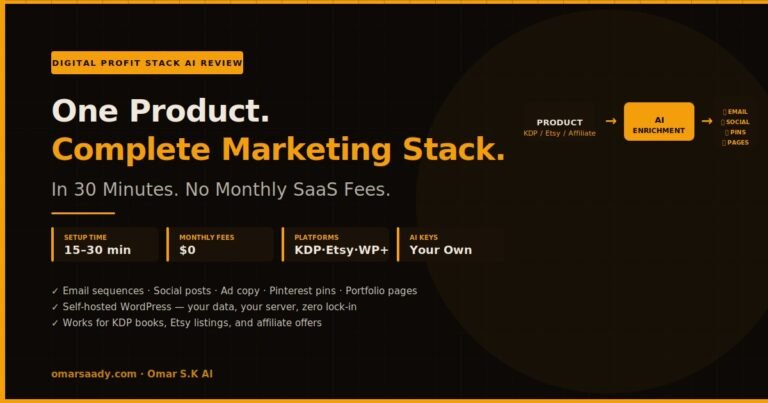
Quick Answer: Digital Profit Stack AI is a self-hosted WordPress platform that imports your product data — whether from KDP, Etsy, WarriorPlus, or manual entry — enriches it with AI-generated positioning, and generates a complete marketing stack: emails, social posts, ad copy, Pinterest pin concepts, and portfolio pages. It uses your own AI API keys (OpenAI, Gemini, or Claude) with no recurring SaaS fees. Most sellers generate a full promotion package for a new product in 15–30 minutes.
You hit publish. You wrote the listing, set the price, added the images, and clicked live.
And then nothing happened.
No flood of sales. No viral moment. Just your product sitting alongside thousands of others, waiting for someone to notice.
So you start promoting. You open ChatGPT and ask for social posts. The output is too generic to use. You try Canva for a Pinterest graphic. Then you realize you still need email copy, ad headlines, a landing page, and platform-specific captions for three different channels — all for the same product you already fully described in your listing.
By the time you’re done, you’ve spent more hours on marketing than you spent creating the product.
I’ve been in this space for seven years. I’ve launched digital products, promoted affiliate offers, and watched hundreds of other sellers go through the same cycle: create something good, then drown in the promotion workload. The product isn’t what holds most people back. Promotion infrastructure is.
The scattered-tools problem is real. Canva for graphics. ChatGPT for copy. Mailchimp for emails. Later for scheduling. Carrd for a landing page. None of them talk to each other. None of them remember your product. Every launch starts from zero.
That’s the exact problem Digital Profit Stack AI was built to solve — and in this review, I’ll show you exactly how it works, who it’s built for, and whether it’s worth adding to your workflow in 2026.
| Metric | Figure | Source |
|---|---|---|
| Businesses using AI as a strategic advantage in 2026 | 72% | Uxify / Statista 2026 |
| Businesses planning to use AI for content creation | 44% | Influencer Marketing Hub 2026 |
| Businesses already profiting from AI adoption | 90% | Uxify Research 2026 |
| Revenue increase after AI adoption (average) | 6–19% | Uxify / Global AI Adoption Survey |
| Time digital sellers spend on promotion vs creation | 2–3x more | Digital Profit Stack AI Internal Data |
| Time to generate a full marketing stack with Digital Profit Stack AI | 15–30 min | Platform Training Documentation |
| Typical monthly cost of scattered SaaS tools | $50–$150+ | Combined Canva, ConvertKit, Later, Carrd pricing |
Why Promotion Is Harder Than It Should Be for Digital Sellers
Here’s the thing most marketing tools won’t admit: the problem isn’t that the tools don’t work. The problem is that they were built in isolation, and using them together creates more friction than they remove.
Think about what promoting a single digital product actually requires:
| Channel | What You Need | Tool You’re Currently Using | Problem |
|---|---|---|---|
| Email list | Subject lines, body copy, follow-up sequence | ChatGPT + Mailchimp / AWeber | Generic output; doesn’t know your product |
| Social media | Platform-specific posts (Instagram, Facebook, X, LinkedIn) | ChatGPT + Canva + Later | Reformatting same info across 4 tabs |
| Paid ads | Headlines, descriptions, CTAs for Google/Meta | ChatGPT + manual writing | Starting from blank prompt every time |
| Vertical images + pin copy + keyword-rich descriptions | Canva + separate research | No integration with your product data | |
| Landing/bridge page | Pre-sell copy, benefit bullets, proof elements, CTA | Carrd / Elementor / built from scratch | Hours of writing per product |
| Portfolio / brand hub | Professional presentation of all your offers | Usually doesn’t exist | Traffic goes directly to marketplace links that convert poorly |
For a KDP author publishing two or three books per month, that table represents 8–12 hours of promotion work per book on top of the writing itself. For an affiliate marketer managing 10+ offers, it means each offer is chronically under-promoted because there’s simply no bandwidth to build proper assets for everything.
The solution isn’t a better version of one of those individual tools. It’s a system that eliminates the gaps between them.
The core insight: Your product already contains all the information needed to generate every marketing asset you’ll ever need for it — title, description, benefits, audience, unique angle. The problem is that you’re manually translating that information into each format, one at a time, every single time you launch something new.
📚 Related: Build Your Promotion Foundation
- Free AI Tools for Affiliate Marketing (2026) — Tested & Ranked
- Affiliate Marketing for Beginners: The One-Post $2,000/Month Formula
- The $1 Copy-Paste Affiliate Method — No Website Required
What Is Digital Profit Stack AI?
Digital Profit Stack AI is a self-hosted WordPress platform that serves as a central command center for digital product promotion. You install it once on your existing WordPress site, connect your own AI API keys — OpenAI, Google Gemini, or Claude — and the system handles the rest: product import, AI enrichment, marketing asset generation, and portfolio publishing, all from one dashboard.
The key distinction from other tools: it’s self-hosted and one-time purchase. No monthly SaaS subscription. No platform lock-in. No recurring fees eating into margins.
It supports all major digital product types:
- KDP books — import from Amazon and generate a complete promotion stack including metadata optimization
- Etsy listings — pull listing data and generate social content, pin graphics, and email sequences
- Affiliate offers — add any WarriorPlus, ClickBank, or JVZoo product manually and build bridge pages and email swipes
- Digital services — structure your service offering into a promotable portfolio asset
- Shopify and other marketplace listings — smart import covers multiple platforms
At its core, Digital Profit Stack AI solves the scattered-tools problem by replacing five or six separate subscriptions with one owned system that knows your products.

How to Use Digital Profit Stack AI to Promote a Product — Step by Step
Here’s the exact workflow, from installing the platform to having a complete promotion stack live.
Step 1: Create a Central Product Record
Import your product directly from its marketplace listing — Amazon, Etsy, Shopify — or add it manually if it lives on WarriorPlus, ClickBank, or another platform. The system pulls the product name, description, category, price, and any available imagery into a structured record.
This becomes your single source of truth for that product. Every marketing asset you ever generate for it will draw from this record — which means you’ll never be copying and pasting product descriptions between tabs again.
Step 2: Enrich With AI-Generated Positioning
This is where the platform earns its name. Once your product record exists, the AI enrichment layer generates:
- 3–5 distinct buyer angles — the same product positioned for different audience segments
- 10+ scroll-stopping hooks — ready for social posts, ad headlines, and email subject lines
- Benefit statements rewritten as outcomes — not “includes 50 prompts” but “never stare at a blank page again”
- Objection responses — the hesitations your buyer has, pre-answered
- Keywords for SEO and ad targeting — including long-tail variations you probably haven’t considered
This enriched profile is what separates the output from generic ChatGPT results. The AI isn’t working from a blank prompt — it’s working from structured, context-rich product intelligence.
If you want to see how AI prompt engineering affects output quality before diving into the platform, my free AI Marketing Prompt Pack shows you the difference between generic and structured AI prompts in real examples.
Step 3: Generate Channel-Specific Assets
With your enriched product profile in place, generating assets is a matter of selecting what you need. The platform produces:
| Asset Type | What’s Generated | Where It Gets Used |
|---|---|---|
| Email sequences | Welcome, launch, follow-up, and abandoned cart emails with subject lines and body copy | AWeber, ConvertKit, GetResponse, any autoresponder |
| Social posts | Platform-formatted posts for Instagram, Facebook, X, and LinkedIn with hashtag sets | Direct publish or scheduling tools like Metricool or Later |
| Ad copy | Headlines, descriptions, and CTAs sized for Google and Meta formats | Meta Ads Manager, Google Ads |
| Pinterest content | Vertical image concepts with overlay text, keyword-rich pin descriptions | Pinterest direct, or automation via TrafficWave Generator |
| Landing/bridge pages | Pre-sell copy, benefit bullets, social proof prompts, CTA structure | WordPress pages, Elementor, Carrd |
| Portfolio showcase | Professional product cards with descriptions, imagery, and purchase links | Your own WordPress portfolio hub |
Step 4: Publish to a Central Portfolio Hub You Control
Instead of sending all traffic directly to your marketplace listings or raw affiliate links, Digital Profit Stack AI includes done-for-you portfolio templates that let you route traffic through a professional hub on your own WordPress site.
This matters for three reasons. First, it builds your brand instead of Amazon’s or Etsy’s. Second, it pre-frames the offer so visitors arrive warmed up rather than landing cold on a checkout page. Third, it gives you analytics — you can see what’s actually getting attention across your entire product catalog, not just within a single marketplace.
For affiliate marketers specifically, this is the difference between sharing a raw affiliate link that converts at 1–2% and a bridge page that pre-sells the offer and converts at 3–8%. I cover this in detail in my guide on how to make affiliate commissions fast.

Before vs After: What the Time and Output Difference Looks Like
Let’s be specific about what this workflow actually produces compared to the scattered approach.
| Factor | Scattered Tools (Before) | Digital Profit Stack AI (After) |
|---|---|---|
| Time per new product launch | 2–3 hours to create promotion materials | 15–30 minutes for a complete stack |
| Asset storage | Scattered across 4+ locations (Google Docs, Canva, email drafts, desktop folders) | All assets in one dashboard per product |
| Brand consistency | Inconsistent tone, formatting, and visual style across channels | All assets draw from the same enriched product profile |
| Monthly tool cost | $50–$150+ across Canva Pro, ConvertKit, Later, Carrd, etc. | One-time purchase — no recurring fees |
| Portfolio / brand hub | Usually doesn’t exist — traffic goes directly to marketplace links | Professional portfolio page live on your own WordPress site |
| Starting point per launch | Blank page — rebuilding every time | Enriched product profile — generating, not creating |
| KDP author (2–3 books/month) | 6–9 hours of promotion work per month | Under 2 hours — more assets, less time |
| Affiliate marketer (10+ offers) | Most offers chronically under-promoted | Full promotion stack for every active offer |
The numbers aren’t dramatic. They’re practical. And practical compounds over time — especially if you’re someone who launches new products regularly or manages a catalog of affiliate offers.
Who Digital Profit Stack AI Is Actually Built For
Not every tool is for everyone, and this one is no exception. Here’s who gets the most out of it:
KDP authors publishing 2+ books per month. The time saving on per-book promotion is the biggest win here. If you’re spending 3 hours promoting every book you write, that’s a full workday per month just on marketing. Getting that down to 30 minutes per book while producing more assets is a meaningful difference.
Affiliate marketers with multiple active offers. Managing separate promotion materials for 10 or 15 different products is nearly impossible without a centralized system. The portfolio hub alone changes how buyers perceive your brand — instead of random links, you have a professional showcase that builds trust before the sale. If you’re new to this model, start with my guide on affiliate marketing for beginners before layering in the tool.
Etsy sellers with 20+ listings. Most Etsy sellers have products scattered across a marketplace with no external brand presence. Digital Profit Stack AI gives them a brand hub that ties their catalog together — and email sequences that bring buyers back.
Digital sellers who want to own their infrastructure. If you’re tired of paying $50–$150 per month across five SaaS tools that don’t integrate, self-hosted is worth exploring. You pay once, the data lives on your server, and no pricing change or platform shutdown takes your assets with it.
It’s a less obvious fit if you’re just starting with your very first product and haven’t validated your offer yet. At that stage, the priority is understanding what your buyer actually wants before building out a full promotion system around it. For that phase, my post on making money online with no experience covers the right first steps.
🎯 Tactical Reads to Pair With This Tool
- How to Make Money with AI in 2026 — 6 Proven Methods
- Make Money on Instagram Reels Without Showing Your Face
- Free Pinterest Traffic for Affiliate Marketers: The Strategy Most Are Sleeping On
- Escape Plan IS1 Review — Automate Your Affiliate Income for $7
The Honest Take: What It Does Well and Where It Has Limits
No tool is perfect, and I won’t pretend this one is.
What it does genuinely well:
- The enrichment layer produces significantly better AI output than you get from a blank ChatGPT prompt — because it has structured product context to work from
- The portfolio publishing feature solves a real problem for sellers who’ve never had a professional showcase outside of their marketplace pages
- Self-hosted means you own everything — your data, your assets, your portfolio — with no platform risk
- The one-time price model eliminates the recurring cost drain that makes most SaaS tools hard to justify for sellers with thin margins
- Supports Amazon KDP, Etsy, Shopify, and manual affiliate offer entries — broad enough to cover most digital business setups
Where to set realistic expectations:
- You’ll need a WordPress site and your own AI API key to get started — not a barrier for most, but not truly zero-setup
- The AI output is a strong first draft, not a finished product. You’ll still refine copy before publishing, particularly for email sequences that represent your brand voice
- Sellers with a single product and no existing catalog will see less immediate value than those with multiple offers to organize
- Like any AI workflow tool, results depend partly on the quality of your initial product record — garbage in, generic out
The bottom line: Digital Profit Stack AI is a genuine time-saver for people already in the game with multiple products or offers. It’s a system, not a shortcut. If you’re willing to set it up correctly and use the enriched profiles before generating assets, the output is meaningfully better than anything you’ll get from cobbling tools together.
Ready to Stop Rebuilding Your Marketing From Scratch?
Digital Profit Stack AI replaces the scattered-tools workflow with one self-hosted dashboard that turns any product — KDP book, Etsy listing, affiliate offer, or digital service — into a complete promotion stack in 30 minutes. One-time price. No recurring fees. Your data on your server.
Self-hosted WordPress · One-time purchase · Connect your own AI keys · No platform lock-in
→ See How Digital Profit Stack AI Works
Want to build your promotion foundation first? Grab the free 100 Ready-to-Use AI Prompts or the AI Marketing Prompt Pack — both free, both immediately useful.
The Promotion Gap Is What Separates Struggling Sellers From Those Building Momentum
I’ve watched enough digital sellers over seven years to see the pattern clearly.
The ones who build consistent income aren’t necessarily creating better products than the ones who struggle. They have better promotion infrastructure. Their new product launches land on an existing system that generates assets quickly, publishes to multiple channels, and keeps their offers visible longer than a single social post that disappears in 48 hours.
The sellers who exhaust themselves start from zero with every launch — new copy, new graphics, new emails, new pages. The ones who compound their results have a system that translates product data into promotion assets without rebuilding everything by hand.
Digital Profit Stack AI is one way to build that system. The scattered-tools approach is another. But the scattered approach has a ceiling — it runs out of bandwidth before it runs out of potential.
For more on building a complete affiliate marketing operation that doesn’t depend on you being present every hour: making affiliate commissions fast with the right systems. For the AI angle on income generation in 2026: 6 proven methods to make money with AI.
Frequently Asked Questions
How long does it take to create marketing assets for a new digital product with AI?
With a centralized AI workflow like Digital Profit Stack AI, most digital sellers generate a complete promotion stack — emails, social posts, ad copy, pin ideas, and portfolio pages — in 15–30 minutes per product. The speed comes from having enriched product data the AI draws from, rather than starting with a blank prompt. Compare this to the 2–3 hours the scattered-tools approach typically requires per product, and the time saving compounds significantly if you’re launching two or three products per month.
Can AI really create marketing content from product data, or is the output still too generic?
Generic AI output is almost always a prompt quality problem, not a capability problem. When you give an AI a raw product description and say “write social posts,” the output mirrors the input — surface-level and interchangeable. Digital Profit Stack AI solves this by adding an enrichment layer before generation: buyer angles, hook variations, benefit-outcome reframes, and objection responses are all added to the product record before any assets are generated. The output is substantially more specific and usable than what you get from a direct ChatGPT prompt. You’ll still refine the copy, but you’re editing a strong draft rather than rewriting a generic one.
Do I need technical skills to set up Digital Profit Stack AI on WordPress?
Basic WordPress familiarity is helpful — if you can install a plugin and navigate a WordPress dashboard, you can set up the platform. You’ll also need your own AI API key from OpenAI, Google, or Anthropic. The setup is step-by-step and doesn’t require coding or design skills. For reference, the majority of small business WordPress users manage their own plugin installations without technical support.
Can Digital Profit Stack AI work for affiliate products I don’t own?
Yes. The platform supports manual product entry for any affiliate offer — WarriorPlus, ClickBank, JVZoo, or any other network. You add the product name, description, your affiliate link, and any available imagery. The system then enriches that product record and generates bridge page copy, email swipes, social posts, and pin ideas — exactly the same workflow as for products you own. For affiliate marketers, the bridge page output is particularly valuable: it pre-frames the offer before the visitor hits the sales page, which typically improves conversions significantly over raw affiliate links.
What’s the difference between Digital Profit Stack AI and just using ChatGPT for marketing copy?
The key differences are structure, memory, and output organization. ChatGPT starts fresh with every conversation — it has no memory of your product, your brand voice, or the assets you’ve already generated. You’re recreating context every time. Digital Profit Stack AI maintains a persistent, enriched product record that all assets draw from consistently. It also organizes the output — emails, social posts, ads, and portfolio pages — in a structured dashboard rather than a chat thread you’ll struggle to find later. And it publishes directly to your WordPress site, which ChatGPT cannot do.
Is Digital Profit Stack AI a subscription or one-time purchase?
It’s a one-time purchase — no monthly SaaS fees. You connect your own AI API keys (billed by your AI provider based on usage, typically a few dollars per month for moderate use), but the platform itself doesn’t charge recurring fees. This is the primary cost advantage over comparable cloud-based tools that charge $50–$150 per month for similar functionality. Self-hosted also means your data and assets remain on your own server, with no platform risk if the vendor changes pricing or shuts down.
📈 Keep Building — More From omarsaady.com
- Free AI Tools for Affiliate Marketing 2026 — Full Tested List
- How to Make Money Online With No Experience — The Honest Guide
- Browse All Free Resources — Prompts, Checklists & Guides
- Affiliate Marketing Without a Website — The $1 Copy-Paste Method
Omar S.K is an affiliate marketer and AI strategist with 7+ years of experience building online income systems. He publishes no-hype guides to real online income at omarsaady.com.
Earnings Disclaimer & Disclosure: This post contains affiliate links. Omar S.K may earn a commission if you purchase Digital Profit Stack AI through a link in this post, at no additional cost to you. Time and output estimates cited are based on platform documentation and third-party reviews. Individual results vary based on product catalog size, implementation quality, and traffic sources. Only tools personally reviewed or believed to benefit readers are recommended on this site. See the full Earnings Disclaimer for complete details.