Getting a website online is easy.
Getting people to actually visit it is where things become difficult.
You can build a polished landing page, publish a useful blog, launch an affiliate offer, create a digital product—or spend weeks perfecting your funnel.
But without traffic?
Almost none of it matters.
That’s why so many beginners eventually search for how to get free website traffic without pouring money into Facebook or Google Ads.
The good news is that you have more free traffic opportunities today than you probably realize.
Pinterest. Reddit. Quora. YouTube. Short-form video. Communities. Search engines. Social posts. Documents. Comments. And now even AI-driven discovery.
The bigger problem isn’t finding another traffic source.
It’s knowing which strategy to use, what to publish, and how to execute it consistently.
And that’s exactly where AI can change the equation.
By the end of this guide, you’ll understand how to combine proven traffic channels with AI to build a much more manageable free-traffic system.
Why Getting Free Website Traffic Is Harder Than It Looks
Search Google for ways to increase website traffic and you’ll get the usual recommendations:
“Post on social media.”
“Start a YouTube channel.”
“Use Pinterest.”
“Answer questions on Quora.”
“Do SEO.”
None of those suggestions are necessarily wrong.
The problem is that they’re incomplete.
Imagine someone tells you:
“Use Reddit to get traffic.”
Okay.
Which subreddit?
What should you post?
Should you include your link?
How do you avoid looking promotional?
What kind of post gets people curious enough to visit your website?
That’s the difference between knowing a traffic source and knowing a traffic strategy.
The same problem happens with AI.
A generic prompt such as:
Write a social media post promoting my website.
usually produces generic promotional copy.
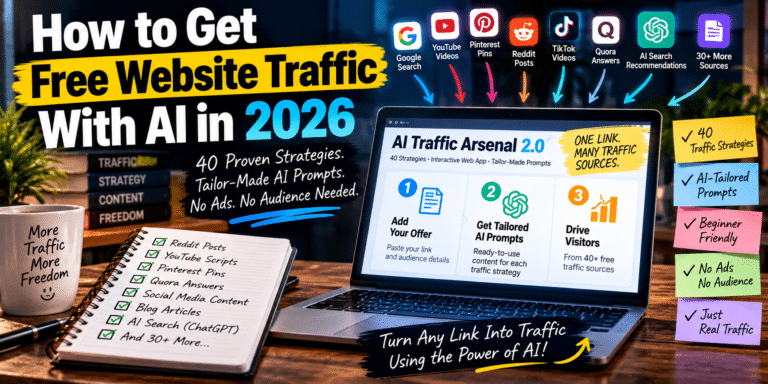
The material behind AI Traffic Arsenal 2.0 makes the same distinction: its approach pairs individual traffic strategies with prompts tailored to the specific offer instead of relying on one generic AI instruction.
That’s a much more useful way to think about AI-assisted traffic.
What Is the Best Way to Get Free Website Traffic?
There isn’t one universally “best” free traffic source.
A better approach is to match the traffic strategy to the offer and audience.
For example:
An informational blog may work naturally with Google, Pinterest and Quora.
A visually interesting niche may be particularly suitable for Pinterest and short-form video.
A software product may benefit from tutorials, YouTube demonstrations and community discussions.
An affiliate offer could use educational content, comparison articles, Q&A content and email follow-up.
This gives us a simple framework:
Offer → Audience → Traffic Channel → Content → CTA
AI becomes useful primarily in the content and execution stages.
Instead of asking AI:
“How do I get traffic?”
give it the context required to execute one specific strategy.
For example:
“Create five Pinterest pin concepts targeting beginner balcony gardeners searching for small-space vegetable growing ideas. Each pin should lead naturally to my guide about growing vegetables on apartment balconies.”
That’s radically more specific.
You’re telling the AI:
who you’re targeting,
where you’re publishing,
what they want, and
where you want the traffic to go.
That’s the principle behind the traffic system we’re discussing.
The supplied product material organizes its 40 strategies across eight categories, including community/Q&A, short video, social posting, Pinterest/visual content, written content, documents/assets and newer AI/search approaches.
The 40-Strategy Approach to Free Traffic
Here’s another mistake worth avoiding:
Trying 40 strategies simultaneously.
Having access to 40 traffic methods doesn’t mean you should execute all 40 this week.
It means you have a toolbox.
Start by categorizing your options.
1. Community and Q&A traffic
Think:
- Quora
- Relevant online communities
- Helpful replies and discussions
These channels work differently from advertising.
People aren’t necessarily waiting for your promotion.
They’re asking questions, discussing problems and looking for useful answers.
Your content needs to contribute first.
2. Short-form video traffic
You don’t necessarily need long YouTube videos.
One useful idea can become a short script for YouTube Shorts, TikTok or another short-video platform.
AI can help transform a topic into hooks, scripts, captions and variations.
3. Social traffic
Instead of repeatedly posting:
Check out my website!
build content around the problem your destination solves.
Teach something.
Show an example.
Share a mistake.
Answer a question.
Then give interested readers a logical path to learn more.
4. Pinterest and visual discovery
Pinterest is particularly interesting because content can continue being discovered beyond the initial publication window.
One article can generate numerous pin concepts targeting different searches and angles.
5. Written-content traffic
Blog posts, tutorials, comparisons and question-based articles can become long-term traffic assets.
They’re slower to create than a comment, but their useful life can be considerably longer.
6. AI-era discovery
Search itself is changing.
The supplied system even includes newer strategies around Answer Engine Optimization (AEO), custom GPT discovery and getting offers surfaced through AI-oriented discovery channels.
This category is newer and should be treated as an additional discovery channel—not a guaranteed replacement for established SEO or social traffic.
How to Use AI to Drive Traffic to Your Website
Here’s a practical workflow you can use even without buying another tool.
Step 1: Define the destination
Don’t start with AI.
Start with the URL.
What exactly are you trying to promote?
A blog article?
Lead magnet?
Affiliate offer?
Product?
YouTube video?
Squeeze page?
Step 2: Define the visitor
Write one sentence:
This page is for ______ who want ______.
For example:
This page is for beginner affiliate marketers who need visitors but don’t have an advertising budget.
That one sentence dramatically improves your AI prompts.
Step 3: Pick ONE traffic strategy
Don’t ask ChatGPT for 100 random ideas.
Choose one execution method.
For example:
Quora answers.
Then build the prompt around that method.
Step 4: Give AI your actual offer context
Tell the AI what the destination contains, who it’s for, the problem it solves, the desired action, and any platform restrictions.
Now the output can be tailored instead of generic.
Step 5: Publish and measure
This part cannot be outsourced to AI.
Track:
Impressions → clicks → opt-ins → conversions
A source generating 500 visitors and zero leads may be less valuable to your business than another source producing 50 highly relevant visitors and 10 leads.
Traffic volume alone isn’t the objective.
Useful traffic is.
If you’d rather have the strategies and AI prompts organized for you instead of constructing every workflow manually, this is essentially what the system behind my 40 Ways to Get Traffic resource is designed to simplify. The underlying product provides strategy-specific prompts that can be tailored around an offer.
See the free traffic system here → t.omarsaady.com/t.html
Why AI Makes This Approach More Practical
Free traffic has never truly been “free.”
You pay with time.
Writing a Quora answer takes time.
Making Pinterest graphics takes time.
Researching keywords takes time.
Writing scripts takes time.
Turning an article into social posts takes time.
This is where AI has genuine utility.
It can compress the execution time.
Suppose you publish one useful 1,500-word article.
Instead of stopping there, AI can help turn that source material into:
- five X posts,
- three Pinterest concepts,
- two short-video scripts,
- a Quora-answer draft,
- an email,
- several hooks,
- and ideas for follow-up articles.
You’re creating a content distribution system around one core asset.
The source material for AI Traffic Arsenal calls one of its AI-era approaches a “Repurposing Engine,” alongside AEO, Reddit SEO and Custom GPT discovery.
That’s much closer to how I would use AI for traffic than asking it to manufacture dozens of disconnected posts every day.
What Results Should You Expect?
This is where expectations matter.
A traffic strategy is not a traffic guarantee.
Different channels have different timelines.
A helpful community response might generate clicks relatively quickly.
A Pinterest pin could take longer to gain distribution.
A search article may take considerably longer to rank.
A short video might get little distribution—or suddenly receive far more impressions than your typical post.
That’s why your first objective shouldn’t be:
“How do I get 10,000 visitors?”
It should be:
“Which repeatable activity brings relevant visitors to my offer?”
Once you’ve identified that, scaling becomes a much more rational decision.
The system featured here helps with execution by categorizing its strategies according to speed and effort. The vendor also states that the package includes 40 strategies, a 133-page guide, an interactive web app and a Traffic Strategist GPT.
Those features can reduce the amount of planning required, but the actual traffic outcome still depends on execution, platform conditions, the offer, content quality and audience response.
A Simple Free-Traffic Plan for Beginners
If you’re starting from zero, don’t build a 40-channel marketing operation.
Choose three complementary layers.
Layer 1 — Quick traffic
Participate where your audience already gathers.
Questions, discussions, communities and relevant social conversations can give you early feedback.
Layer 2 — Discovery traffic
Create searchable or discoverable assets such as Pinterest pins, useful videos and Q&A content.
Layer 3 — Long-term assets
Build content you own.
Articles, an email list, lead magnets and useful resources give you something that isn’t completely dependent on tomorrow’s social algorithm.
Then use AI to help repurpose each core idea across those layers.
That creates a far more sustainable system than constantly asking:
“Where can I drop my link today?”
The Bottom Line
The biggest free-traffic opportunity in 2026 isn’t a secret website or a magical AI prompt.
It’s the combination of:
proven distribution strategies + relevant content + faster AI-assisted execution + tracking.
You don’t need to master 40 traffic methods immediately.
You need enough options to find the few that fit your offer, your audience and your available time.
That’s why I like the concept behind the 40-strategy system: instead of betting everything on one channel, you get a menu of traffic plays and use AI to reduce the execution workload.
If you want to see how that system works before deciding whether it fits what you’re promoting, I’ve created a simple access page here:
Explore 40 Ways to Get Traffic → t.omarsaady.com/t.html
Look through the approach, pick a strategy relevant to your own site or offer, and judge it based on whether it’s something you can actually execute consistently.
Frequently Asked Questions
Can AI really generate free website traffic?
AI itself doesn’t generate traffic simply because you create content with it. It can help research, draft, repurpose and adapt content for different traffic strategies. Distribution, relevance and audience response still determine whether people actually visit.
Do I need paid advertising to get website visitors?
No. Search, Pinterest, YouTube, Reddit, Quora, communities, social content and other organic channels can generate visitors without paying for each click. However, “free” traffic still requires time and execution.
How many free traffic sources should a beginner use?
Start with a small number you can execute consistently. One faster community/social channel plus one discoverability channel and one owned long-term content asset is a practical starting structure. Expand after your tracking shows what’s actually producing useful visitors.