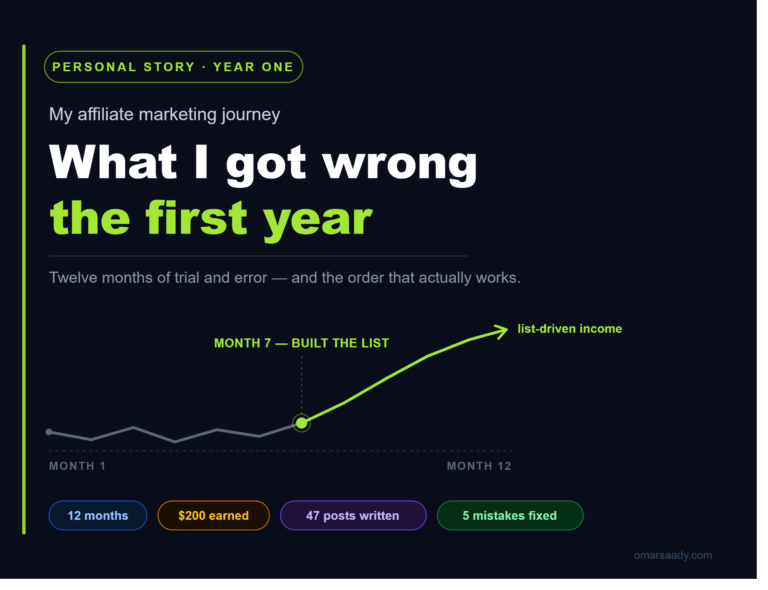
Twelve months of expensive trial and error, distilled into the mistakes you don’t have to repeat — and the exact order that actually works.
✍ Omar S.K📅 June 10, 2026 · Updated June 20, 2026🏷 Affiliate Marketing · Personal Story

My affiliate marketing journey nearly ended before it ever began — and if you’re reading this feeling frustrated, invisible, and quietly wondering whether any of this actually works, I want you to know: I’ve been exactly where you are.
You did everything they told you to do. You signed up for the courses. You watched the YouTube videos at 1.5x speed until your eyes dried out. You picked a niche, set up your links, and waited. And then… nothing. The commissions didn’t come. The traffic didn’t show up. And somewhere around month three, the self-doubt arrived instead.
That feeling — the hollow mix of embarrassment and exhaustion — is what I want to talk about today. Because the real cost of the first year in affiliate marketing isn’t money. It’s time, confidence, and the slow erosion of belief in something that could genuinely change your life. I wasted nearly twelve months on approaches that were almost right but fundamentally broken. What I’m sharing here is the map I wish I’d had — built from every mistake I made so you don’t have to repeat them.
Related Reading
- Why You’re Not Making Money With Affiliate Marketing (Yet)
- Affiliate Marketing in 2026: Why Most Beginners Fail in 90 Days
- Affiliate Marketing for Beginners: The “One Post” $2,000/Month Formula
The Lie That Almost Cost Me Everything
When I first started affiliate marketing, I believed the biggest myth in this industry: that success was about finding the right product.
I jumped between offers constantly. WarriorPlus one week, ClickBank the next. I promoted fitness products, software tools, courses on forex, and at least two “done-for-you” systems that turned out to be a PDF and a password to a members area with outdated training videos.
My logic was simple and completely wrong: if a product converts well for someone else, it should convert for me too. What I didn’t understand — what nobody told me in plain language — is that conversion is a system, not a product feature. The product matters a fraction as much as the infrastructure around it: the squeeze page, the email sequence, the trust you’ve built with your audience before you ever show them a link.
I had none of that. I was sending cold traffic directly to sales pages and calling it a strategy.
What Actually Drives Commissions
The affiliate marketing funnel is not complicated, but it is sequential. Every step has to exist before the next one works.
- Traffic — people who are already curious about a problem you solve
- Opt-in — capturing their email before they leave
- Trust sequence — a series of emails that deliver value before pitching anything
- Offer — presented at the moment of maximum trust and relevance
Skip any one of these and the whole thing collapses. I skipped steps two and three entirely for the first six months. I was essentially fishing without bait, wondering why nothing was biting.
The Traffic Trap: Why More Visitors Won’t Save You
Here’s what my first year looked like in numbers: I drove somewhere between 8,000 and 12,000 clicks across various affiliate campaigns. My total commission for that period? Less than $200.
That’s not a traffic problem. That’s a conversion architecture problem.
The MMO (make money online) space is saturated with advice about traffic — Pinterest strategies, SEO hacks, TikTok growth formulas, paid ad blueprints. And traffic does matter. But here’s what that advice almost never addresses: cold traffic is nearly useless without a warm-up system.

When someone finds your content for the first time, they don’t trust you. They don’t know you. They are one distraction away from closing the tab forever. The only way to convert a stranger into a buyer is to earn their attention over time — and the only way to do that without losing them is to get their email address first.
The numbers back this up. Email marketing delivers an average return of ↗ $36 for every $1 spent, and converts at roughly ↗ 4.24%, compared to 0.59% for social media — a 7x gap that comes almost entirely from the fact that subscribers already know and trust you before you ever pitch anything.
I didn’t build my list until month seven. It was the single most expensive mistake of my first year, and I’d made it based on advice I’d absorbed from people who kept saying “you don’t need a list to start.” Technically true. Strategically catastrophic.
The Platform Mistake That Multiplied Everything
My second major traffic mistake was building on rented land. I poured time into social media profiles — content, engagement, follower growth — without a single layer of ownership underneath it. One algorithm change wiped out my organic reach. One platform policy update made half my promotional content suddenly non-compliant.
An email list is the only audience you actually own. Every hour you spend growing followers without simultaneously building an email list is an hour building someone else’s asset. I eventually found more sustainable ground with Pinterest’s evergreen search traffic and a more structured approach to getting affiliate traffic fast — both of which work because they feed an owned list instead of just a rented feed.
Keep Learning
- How to Make Money Online With No Experience in 2026
- The Best Way to Build Passive Affiliate Income From Scratch
- How to Make Money Online Automatically Without Ads or Experience
The Niche Confusion That Kept Me Spinning
For nine months, I couldn’t answer the question: “Who is my content for?”
I thought “beginners who want to make money online” was a niche. It’s not. It’s a demographic the size of a continent, with wildly different starting points, fears, budgets, and timelines.
Real niche clarity sounds like this: “I help complete beginners — people who’ve never made a dollar online — get their first affiliate commission using free traffic and AI tools, without quitting their job or building a personal brand.”
That’s specific enough to repel the wrong people (which is good) and magnetic enough to deeply attract the right ones (which is everything).
The vagueness of my early positioning meant I was writing content that spoke to everyone and converted no one. My blog posts were technically accurate but emotionally disconnected. I was addressing symptoms rather than the specific, urgent pain my ideal reader was living with on a Tuesday night after a long shift.
How to Find Positioning That Actually Works
The question to ask isn’t “what do I want to write about?” It’s “what is the exact sentence my ideal reader types into Google at 11pm when they’re desperate for an answer?”
Those searches are your content calendar. Those fears are your headlines. Those desires are your offers.
When I finally got specific — when I committed to the AI-powered affiliate marketing space targeting complete beginners — everything changed. Not overnight. But directionally and permanently.
The Content Volume Trap (And the Compound Interest of Quality)
I published 47 posts in my first year. Most of them were mediocre.
They were keyword-stuffed, thin, and structured around what I thought SEO wanted rather than what a real human needed. I was optimizing for search engines before I’d earned the right — before I had the topical authority, the backlinks, the engagement signals that actually drive organic rankings.
What I should have written: 12 exceptional posts that each went deeper than anything else on the internet on that specific sub-topic. Posts that earned bookmarks, shares, and return visitors. Posts that answered a question so completely that the reader felt they’d found a mentor, not just an article.
83%of marketers say quality beats quantity, even posting less often ↗ Source
9.5xmore leads from high-quality content vs low-quality, untargeted content ↗ Source
12 vs 47exceptional posts I should have written, instead of the mediocre ones I did
Here’s the uncomfortable truth about content volume: publishing more mediocre content doesn’t compound. It dilutes. Google’s quality signals penalize thin content clusters. Readers who land on an underwhelming post don’t come back. You’re not building authority — you’re building noise.
Quality compounds. A single genuinely useful, thorough, empathetic piece of content continues to earn traffic, trust, and backlinks for years. Twelve of those beats four hundred hollow ones every time.
The Tool Obsession That Kept Me Broke and Busy
I spent approximately $1,400 in my first year on tools, courses, and software. I used maybe 20% of what I bought. The rest either gathered digital dust or overlapped with something I already had.
This is one of the most common, least-discussed forms of affiliate marketing self-sabotage: mistaking tool acquisition for business progress.
There’s a real, well-documented pattern behind this called ↗ shiny object syndrome — the tendency for entrepreneurs to chase the next tool or course because the purchase itself produces a small hit of accomplishment, even when it doesn’t move the business forward. The fix isn’t willpower. It’s having so few next steps defined that there’s nothing left to be distracted by.
There’s a powerful psychological reason this happens. Buying a new tool or course produces a dopamine hit that feels identical to accomplishment. The purchase feels like a step forward. It’s measurable, tangible, and immediate in a space where real results are slow and invisible.
The antidote is brutal simplicity in your tech stack — especially at the start. Here’s what you actually need to launch a functioning affiliate operation:
- ✓A free autoresponder with automation (MailerLite’s free tier handles this perfectly)
- ✓A simple landing page builder (Carrd will cost you $19/year)
- ✓A traffic source you commit to for at least 90 days
- ✓One affiliate offer with a proven funnel behind it
That’s it. Everything else is optimization for problems you don’t have yet.
When Tools Actually Help
Tools earn their place when you’ve already validated the fundamentals. Once you know your squeeze page converts, then invest in split-testing software. Once your email sequence generates consistent replies, then upgrade your autoresponder. The few tools genuinely worth adding early are the ones that remove hours of manual work rather than adding new decisions — this is the only category I’d recommend looking at before your fundamentals are proven, and even then, free AI tools or no-code automation cover most of what a beginner actually needs.
Build the machine first. Optimize the machine second. Buy the tools that serve the machine third.
The High-Ticket Revelation I Arrived at Too Late
For most of my first year, I promoted low-ticket products — $17 to $47 offers — because they felt easier to sell. Lower price point, lower resistance, right?
What I didn’t account for: it takes nearly as much effort to generate a $17 commission as a $500 one. The traffic cost is the same. The content creation investment is identical. The email sequence, the relationship-building, the trust — all of it is required regardless of the price point on the other side.
The math is brutal once you see it. Earning $5,000 from $5 commissions requires 1,000 sales. The same $5,000 from $500 commissions requires just 10. ↗ Selfemployed.com notes a 1% conversion rate on 2,000 monthly visitors at a $500 average commission can produce $10,000 a month — yet only ↗ 4–8% of affiliate marketers ever reach six figures, almost always because they never made this shift.
Promoting low-ticket offers when you’re just starting out makes sense for building confidence and understanding the conversion process. But staying there indefinitely is how you build a business that requires enormous volume to produce modest results.
The shift that finally moved the needle for me was aligning with a high-ticket offer — one with a proven funnel, real coaching behind it, and commission structures that rewarded the effort I was already putting in. That change didn’t require more traffic. It required the same traffic, directed differently, with a higher-value outcome on the other side. A structured system like MAP is built around exactly this shift — automated profits from offers that actually justify the work.
If you’re generating traffic and opt-ins but your commissions don’t reflect the effort, this is almost certainly where the disconnect lives.
What I Know Now That I Didn’t Know Then
Looking back across twelve months of expensive trial and error, the pattern is clear. Every major mistake shared the same root cause: I was optimizing inputs before I understood the system.
I focused on publishing frequency before content quality. I focused on traffic volume before conversion infrastructure. I focused on offer selection before audience clarity. I focused on tool acquisition before offer validation.
The sequence matters more than the effort. You can work extremely hard in exactly the wrong order and produce nothing — while someone working fewer hours in the right sequence builds a real, compounding business.
1- Get clear on your person: The specific person you’re helping and the specific transformation you’re delivering — not “beginners,” but a sentence specific enough to repel the wrong people.
2- Build the minimum viable funnel: One lead magnet, one squeeze page, one email sequence, one offer. Nothing more until this is proven.
3- Choose one traffic source: Commit to it for 90 days minimum before evaluating results. Switching early resets the clock every time.
4- Let data, not emotion, drive optimization: Traffic to opt-in rate. Opt-in to open rate. Open to click rate. Click to conversion rate. Fix the weakest link, not the one that feels most exciting to fix.
5- Scale what works: Replicate the proven funnel to new offers, new traffic sources, or new segments — only after the original is proven.
This isn’t revolutionary. It’s the method that every successful affiliate marketer I’ve ever studied eventually converged on, usually after the same expensive period of learning I went through.
The Mindset Reality Nobody Posts About
Affiliate marketing in the first year is a patience game disguised as a skill game.
Yes, the skills matter. Copy, traffic strategy, funnel architecture, email psychology — all of it is learnable and all of it compounds. But the reason most people quit before the skills start paying off isn’t because they couldn’t learn. It’s because the timeline between effort and result is long enough to feel like failure.

Organic traffic takes months to build. Email lists grow slowly at first, then faster. Trust — the fundamental currency of every commission you’ll ever earn — accumulates at a pace that feels invisible until one day it’s undeniable.
The people who make it through year one aren’t necessarily smarter, more talented, or luckier. They’re the ones who understood early that the delayed return is the whole game — and built the habits and systems to show up anyway.
Your Next Step Doesn’t Have to Look Like Mine
Every affiliate marketing journey is different. Your niche, your audience, your existing skills, your available time — all of it shapes the specific version of this path that’s right for you.
What doesn’t change is the structure underneath. The funnel. The relationship. The trust. The offer. These are the constants.
If you’re somewhere in your first year right now — frustrated, uncertain, wondering if you’ve wasted your time — I want to leave you with this: the time isn’t wasted. The mistakes are the curriculum. Every wrong turn is one fewer wrong turn ahead of you.
What matters now is what you do with the map.
Ready to Stop Guessing?
If you’re ready to stop guessing and start building a real, structured affiliate income system, start with the free resources on this site — the beginner’s affiliate guide, the high-ticket funnel blueprint, and the complete AI tool stack. Browse Free Resources →
No opt-in required to browse · 97+ free downloads
Frequently Asked Questions
How long does it realistically take to make money with affiliate marketing?
Most beginners need 6 to 12 months of consistent work before seeing reliable commissions. Organic traffic and email trust both build slowly at first, then compound. The first 90 days are almost always about building infrastructure, not generating income.
Do I need an email list to succeed in affiliate marketing?
You can generate sales without one, but a list is the only audience you actually own. Cold traffic sent straight to an offer converts far lower than traffic that’s been warmed up through a trust sequence first.
Should beginners promote low-ticket or high-ticket affiliate offers?
Low-ticket offers are useful early on for building confidence and learning the conversion process. But the traffic, content, and trust-building effort required is nearly identical at higher price points, so staying low-ticket indefinitely means needing far more volume for the same result.
Sources & External References
- Constant Contact — Email Marketing Statistics & Trends for 2026
- WSI — Email Marketing in 2026 Is Still the Highest Driver of ROI
- Charlsie Niemiec — Content Quality vs Quantity Isn’t Debatable
- Aspiration Marketing — Content Quality vs. Quantity for 2026
- Lindsay Kirsch — Entrepreneurs and Shiny Object Syndrome
- Self Employed — High Ticket Affiliate Marketing: Complete Guide
- Lead Advisors — High-Ticket Affiliate Marketing: Big Commissions With Fewer Sales
OS
Omar S.KAffiliate marketer & content creator with 7+ years in the make-money-online space. Founder of omarsaady.com — sharing the mistakes and systems that actually moved the needle, no hype.
More From omarsaady.com
- Best Affiliate Marketing System 2026: How MAP Unlocks Automated Profits
- Free AI Tools for Affiliate Marketing (2026) — Tested & Ranked
- Free Pinterest Traffic for Affiliate Marketers: The Strategy Most People Are Sleeping On
Disclosure: Some links on this page may be affiliate links. If you purchase through one, I may earn a commission at no extra cost to you. Results from any affiliate marketing strategy vary based on individual effort, niche, and consistency. Nothing in this post constitutes a guarantee of income.