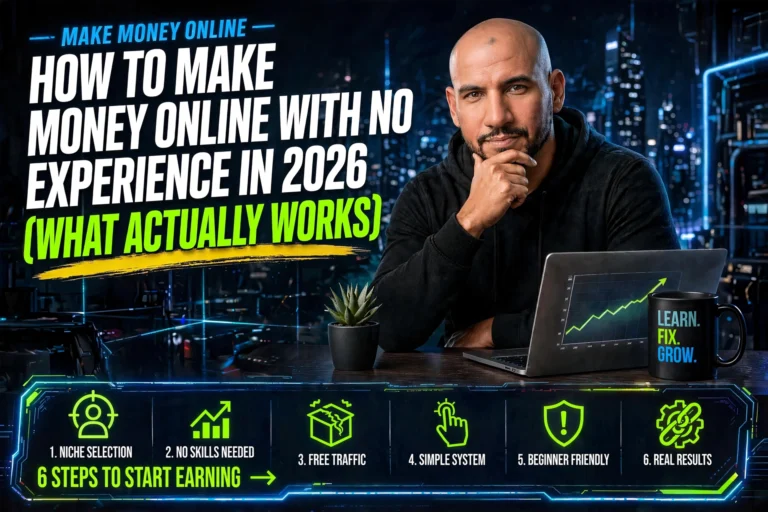
How to Make Money with ChatGPT for Beginners
(2026 Honest Guide)
Look — if you’ve Googled “how to make money with ChatGPT for beginners” and landed here, I’m going to give you the honest version nobody else will.
Not the “$10,000 a month on autopilot” fantasy. Not the “just ask ChatGPT to write your business plan” fluff. The actual mechanics of what works, what doesn’t, and why most beginners quit too early.
I’ve spent over seven years building income online and the past two specifically testing ChatGPT-powered income streams — affiliate content, freelance services, digital products, and more. Here’s what I know.
You can make real money with ChatGPT as a beginner — but it’s a tool, not an ATM. The fastest paths are freelance writing/content services (income in 1–2 weeks) and AI-assisted affiliate blogging (income in 60–90 days). Start with one method, build one skill, stay consistent for 90 days.
- Freelance AI writing: $200–$1,500/month within 30–60 days
- Affiliate content blogging: $100–$2,000+/month by month 3–6
- Digital product creation: $50–$500/month passively once live
- ChatGPT Plus not required to start — free tier works fine
Why Most People Fail at Making Money with ChatGPT
Here’s the thing most “ChatGPT money” YouTube videos won’t tell you: ChatGPT doesn’t make money — you do. ChatGPT is the tool that makes you faster, not the business model itself.
The people failing are copying raw AI output and hoping for the best. They’re trying 5 methods at once. They’re quitting after two weeks because they haven’t made $10,000 yet.
The people winning are doing the opposite. They pick ONE method, spend two weeks learning it, ship their first output (even if it’s not perfect), and iterate. Simple, boring, it works.
How to Make Money with ChatGPT for Beginners: 6 Methods That Actually Work
These aren’t hypothetical. These are the methods I’ve either done myself or seen real beginners use to get from zero to their first $500+ month.
| Method | Time to First $ | Monthly Potential | Effort Level |
|---|---|---|---|
| Freelance AI Writing | 1–2 weeks | $500–$3,000 | Medium |
| Affiliate Blog Content | 60–90 days | $200–$5,000+ | Medium |
| Social Media Content Packages | 1–3 weeks | $300–$2,000 | Low |
| Digital Products (Ebooks, Templates) | 3–6 weeks | $50–$1,000 | Low |
| Email Newsletter Services | 2–4 weeks | $200–$1,500 | Medium |
| Prompt Engineering Packages | 2–3 weeks | $100–$800 | Low |
The 6 Methods Broken Down
This is the fastest path to income for a complete beginner. Businesses need blog posts, product descriptions, email sequences, and landing page copy — constantly. Use ChatGPT to produce drafts 10x faster, then edit and personalize before delivery.
Where to start: Fiverr or Upwork. Create a profile, write 3 sample pieces as your portfolio, price yourself at $15–$30 per article to start. Raise rates after your first 5 reviews.
The real skill: Prompting ChatGPT to match the client’s brand voice, then editing the output to sound human. Takes about a week to get good at this.
💰 Realistic Month 1: $200–$600This is how I generate a significant chunk of my passive income. Use ChatGPT to research, outline, and draft SEO blog posts targeting buyer-intent keywords. The posts attract organic traffic. Traffic clicks affiliate links. You earn commissions.
The key insight: Don’t just ask ChatGPT to “write a blog post.” Give it a keyword, a target audience, a pain point, and ask for a detailed outline first. Then build section by section.
Timeline expectation: 60–90 days minimum before Google starts ranking new content. Don’t quit at week 3.
💰 Realistic Month 3: $100–$800Small businesses, coaches, and local services desperately need social content but have no time to create it. Offer a monthly package: 30 posts across Instagram, Facebook, or LinkedIn — using ChatGPT to do the heavy lifting.
How to price it: Start at $150–$300/month per client for 30 captions + hashtags. Land 3 clients and you’re at $450–$900/month working maybe 5 hours a week.
💰 Realistic Month 2: $300–$900Use ChatGPT to draft an ebook, cheat sheet, or template bundle on a niche topic people already pay to learn. Sell it on Gumroad, Etsy, or your own site. Once created, it earns passively.
Best niches for this: Marketing, productivity, personal finance, fitness nutrition plans, resume templates, and business starter kits.
Don’t overthink it: A 20-page PDF packed with value sells better than a 200-page epic nobody finishes. Use ChatGPT to build it in 2–3 days.
💰 Realistic Monthly Passive: $50–$400Businesses with email lists often hate writing them. Offer a “done-for-you email newsletter” service — 4 emails per month, AI-drafted, then personalized. Charge $100–$300 per client per month. Recurring income.
Why this works: Email is still the highest-converting marketing channel. Businesses know it. They just need someone to write it for them — that’s you with ChatGPT as your co-writer.
💰 Realistic Month 2: $200–$900Most business owners have no idea how to use ChatGPT effectively. Sell them a custom prompt library for their specific business — a set of 20–50 tested, optimized prompts built for their industry. Charge $50–$200 per pack.
This is a hidden gem: Low competition, high perceived value, easy to deliver. A real estate agent will pay $100 for 30 prompts that help them write listings, emails, and social posts instantly.
💰 Realistic Month 1: $100–$400How Long Does It Take to Make Money with ChatGPT? (Honest Timeline)
I’m going to be real with you here because everyone else gives you the Instagram highlight reel timeline.
- Week 1–2: Learning your chosen method, building your first outputs, setting up your platform
- Week 3–4: First client inquiry or first traffic to your blog. Income likely still $0
- Month 2: First $50–$200 if you stayed consistent. This is where most people quit. Don’t.
- Month 3: $200–$800/month becomes realistic for freelancing; $50–$300 for passive content
- Month 6: $1,000+/month is achievable for anyone who did the work in months 1–5
What Most People Won’t Tell You About ChatGPT Side Hustles
Nobody talks about this stuff in the YouTube thumbnails, so I will.
AI detection is real — and fixable
Tools like Originality.ai and Content at Scale’s detector will flag raw ChatGPT output. The fix: rewrite 20–30% in your own voice, add specific examples, use first-person where appropriate, and vary your sentence structure. Five minutes of editing makes the difference between flagged and passed.
Clients aren’t anti-AI — they’re anti-lazy
Most clients don’t care that you used AI as long as the final product is excellent. They care when AI output is clearly generic and unedited. Set the standard higher than the AI’s first draft and you’ll keep clients long-term.
Traffic is the actual bottleneck — not content
ChatGPT can create unlimited content. But content without a distribution strategy earns nothing. This is why I pair AI content creation with Pinterest traffic automation and email list building — two channels that compound over time.
The Fastest Way to Start Making Money with ChatGPT Today
If you want the most direct path, here it is:
- Go to ChatGPT (free tier is fine) and write 3 sample blog posts or social captions in a niche you know anything about
- Edit them aggressively — add your voice, specific details, and real-world examples
- Open a Fiverr gig offering “AI-assisted blog posts” or “social media content packages” — use those samples as your portfolio
- Set your price at $15–$25 to start and go to $0 in week 1 (that’s normal, keep going)
- Get your first 3 reviews, then raise your price and start refining your service
The people making real money with ChatGPT aren’t smarter than you. They’re just six months ahead of you because they started six months ago.
Get the AI Affiliate Blueprint That Runs on ChatGPT
180+ plug-and-play AI prompts, a 7-day commission roadmap, and the exact tools I use to generate affiliate income with AI every day — yours free, instantly.
⚡ Get Instant Free Access